Experiments · 2026/27

From the lab
into real life.

MOTYNIA is testing how consumer-grade humanoids can learn dependable roles in human environments. We begin under controlled conditions, then move one carefully bounded capability at a time toward the field.

The laboratory program reflects MOTYNIA’s current early-prototype stage. Office and production-floor images visualize proposed pilot contexts and are not documentary photographs of completed deployments.

ProgramMOTYNIA Field Readiness 01
Current stageEarly lab prototypes
Current windowQ3–Q4 2026
Next gateSupervised field pilot
LAB / 01

Learning the handoff.

A controlled integration program focused on the smallest useful unit of collaboration: perceiving an offered object, approaching at the right speed, receiving it safely, and confirming completion in a way a person can immediately understand.

Active prototypeQ3–Q4 2026Controlled lab
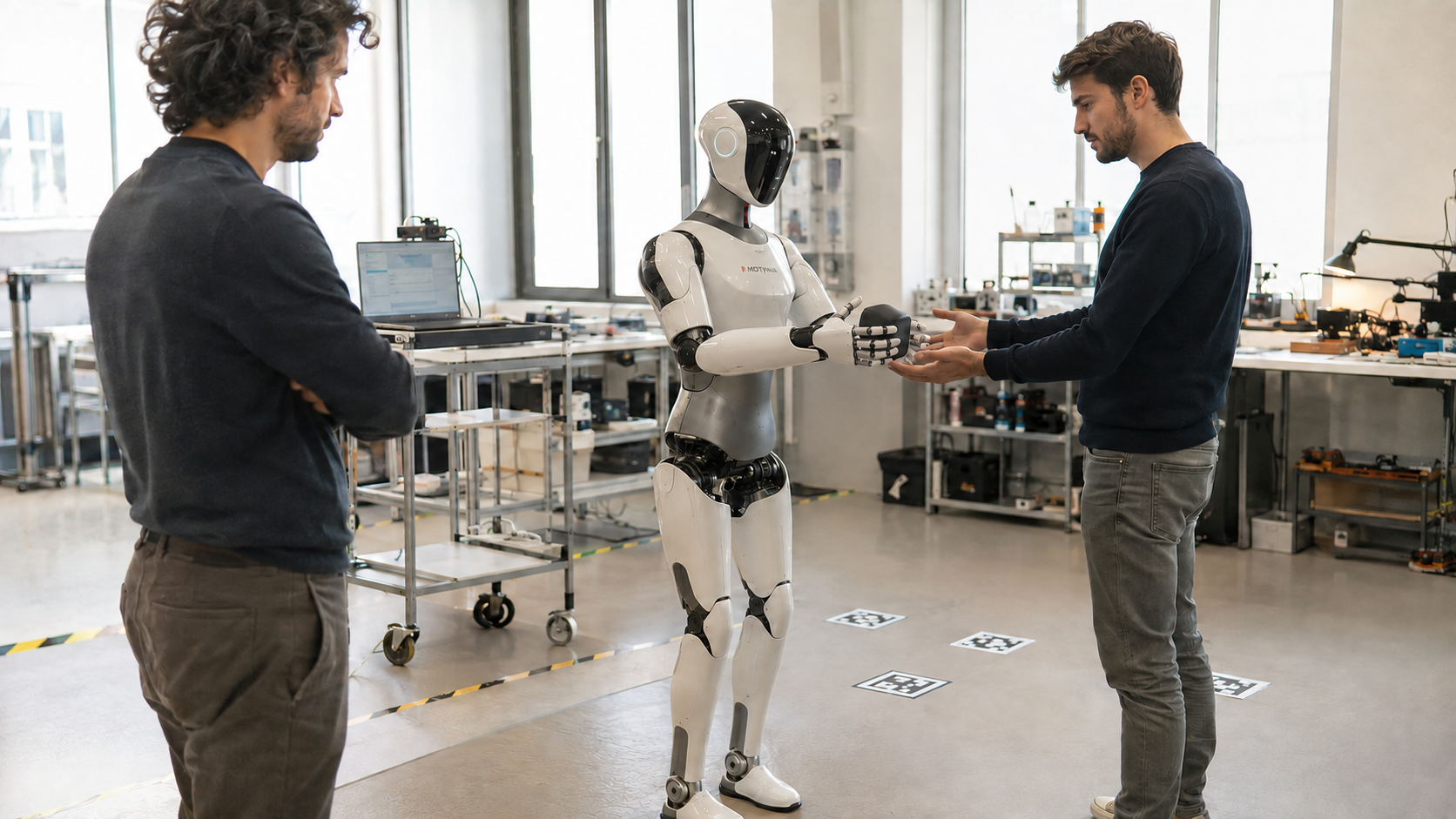
Engineers supervising a humanoid robot object-handoff experiment in a laboratory
Representative image · Early integration laboratoryProgram 01 / Interaction

Goal

Make close-range human–robot exchange predictable, legible, and comfortable.

Setup

Tabletop objects, marked zones, supervised autonomy, varied users, and repeatable task sequences.

What we are learning

Where motion timing, gaze, hand position, and verbal cues reduce hesitation and failed transfers.
FIELD / 02

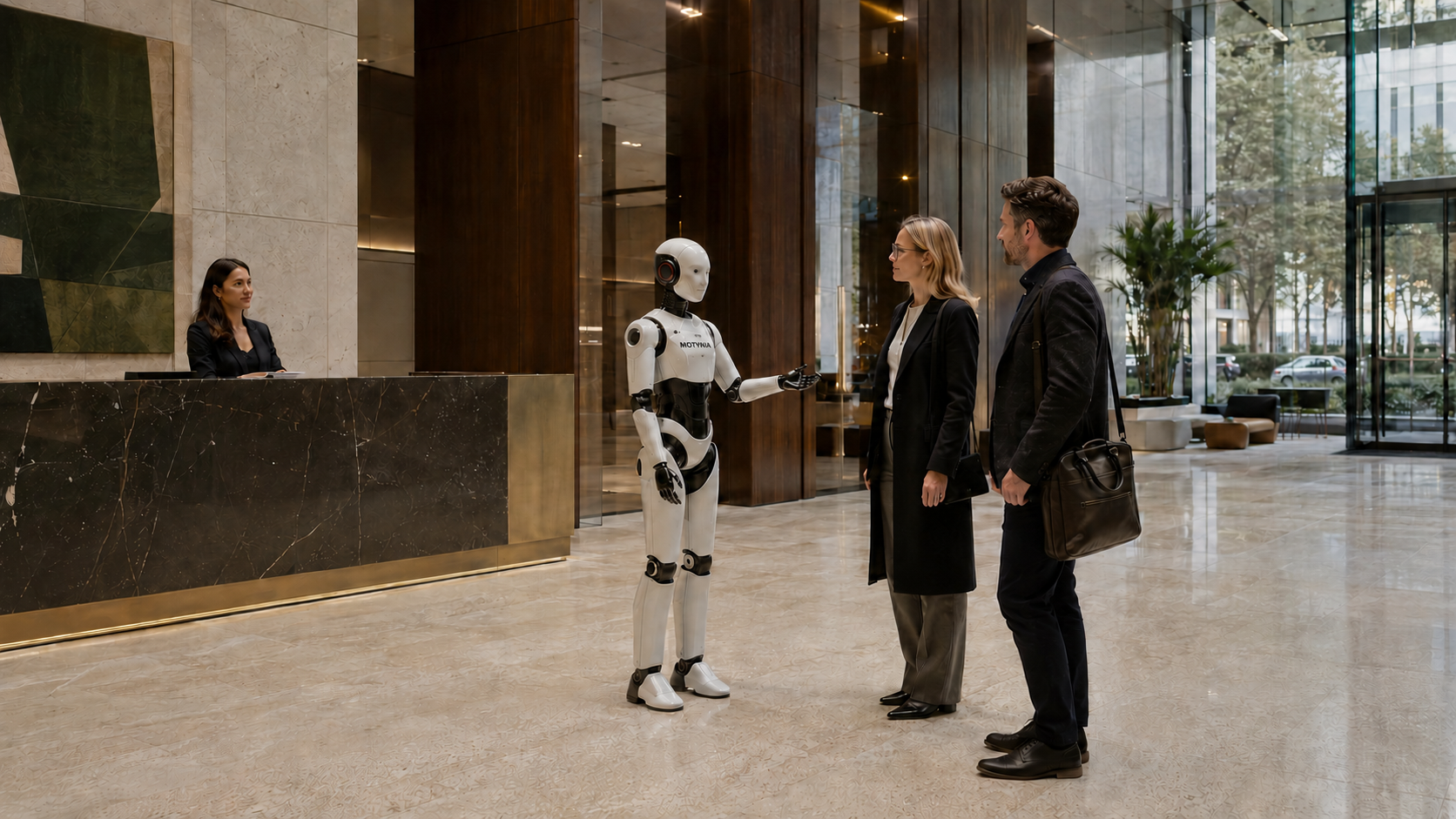
A reception that can move.

A proposed corporate pilot for a humanoid that greets expected visitors, identifies their destination, escorts them through shared spaces, and brings a human colleague into the interaction whenever judgment is required.

Target pilot2027Partner sought
Humanoid robot guiding visitors in a refined corporate lobby
Concept visualization · Proposed corporate pilotProgram 02 / Workplace

Goal

Test whether embodied guidance improves arrival, orientation, and accessibility without adding friction.

Proposed setup

One lobby, limited destinations, scheduled visitors, staff oversight, and a clear human handoff.

Learning question

When does a moving, speaking interface feel more natural than signage, screens, or a fixed kiosk?

FIELD / 03

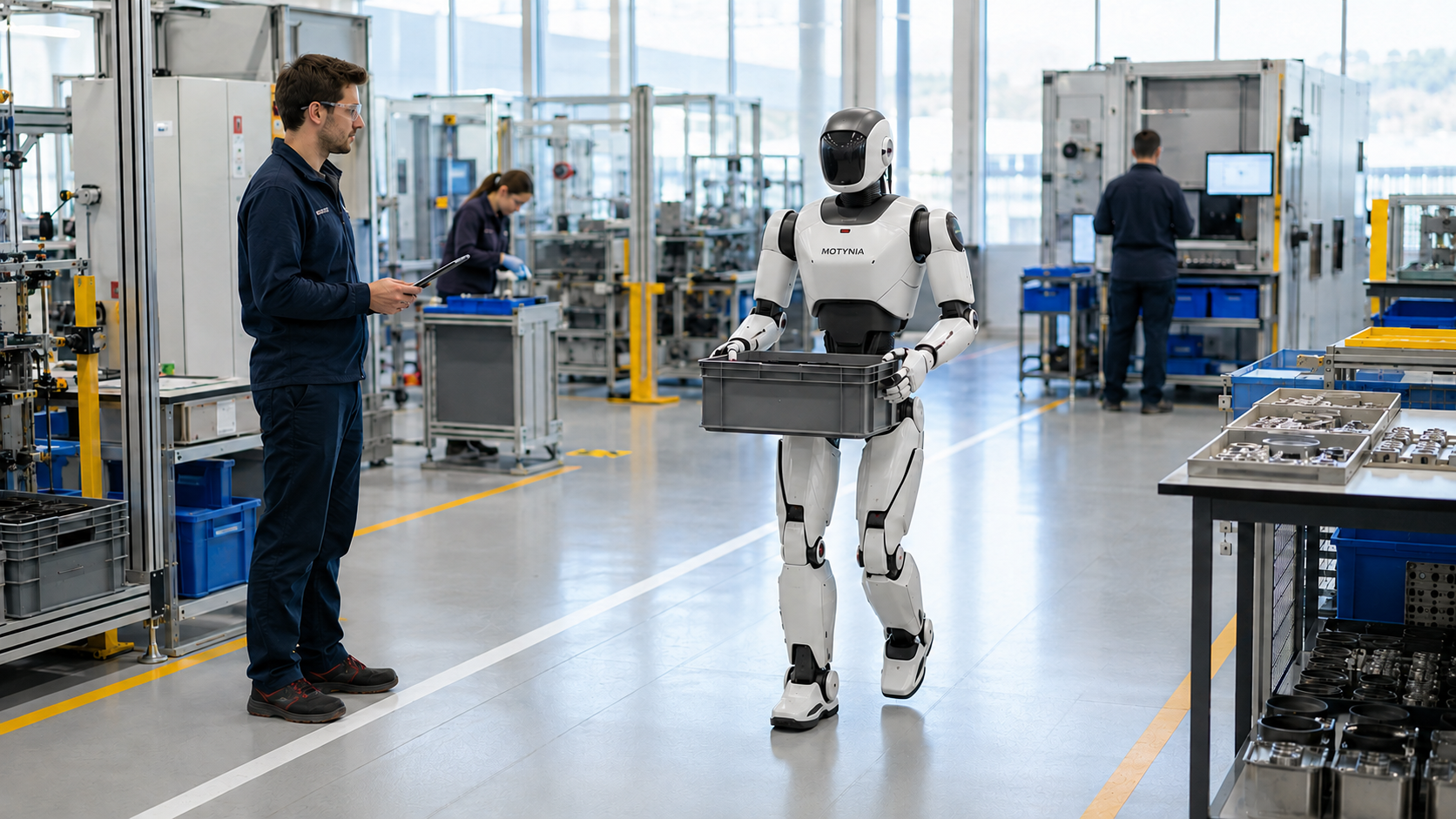
Material flow, at human scale.

A proposed light-manufacturing pilot for short, repetitive tote movements between existing work cells—using the same aisles, containers, and visual cues as people, under direct operational supervision.

Scoping2027Partner sought
Technician supervising a humanoid robot transporting a parts tote on a production floor
Concept visualization · Proposed production pilotProgram 03 / Industry

Goal

Reduce low-value walking and carrying while preserving the flexibility of a human-oriented line.

Proposed setup

Fixed route, light payload, low speed, geofenced work zone, technician oversight, and stop-safe interactions.

Learning question

Can a general-purpose humanoid create value where layouts and tasks change too often for fixed automation?

Security readiness

Every operational milestone has a security gate.

Before a capability moves from the laboratory into a partner environment, MOTYNIA evaluates its attack surface, access model, data handling, failure behavior, update process, and monitoring requirements.

01

Threat modeled

02

Adversarially tested

03

Deployed with bounded permissions

04

Continuously monitored and updated

A deliberate path
to the field.

Dates describe the current program hypothesis and will be refined with hardware, research, and field partners.

Interaction primitives

Handoffs, approach, stop behavior, acknowledgment, and recovery.

Workflow assembly

Combine reliable primitives into bounded, supervised tasks.

Partner simulation

Recreate one partner environment and test the complete role.

Supervised pilot

Move into the field with narrow scope and explicit success gates.

Pilot with MOTYNIA

Bring us one real workflow.

Discuss a secure pilot